Perform multi-dimensional scaling (MDS) also know as Principal Coordinate
Analysis (PCoA). These functions are wrappers for
scater::calculateMDS.
getMDS(x, ...)

addMDS(x, ...)

# S4 method for class 'SingleCellExperiment'
addMDS(x, name = "MDS", ...)

# S4 method for class 'SingleCellExperiment'
getMDS(x, assay.type = "counts", ...)

# S4 method for class 'TreeSummarizedExperiment'
getMDS(x, assay.type = "counts", ...)
Arguments
- x
a
SummarizedExperimentobject.- ...
additional arguments.
FUN:Function. A function that is applied to calculate dissimilarity. (Default:getDissimilarity)
- name
Character scalar. A name for thereducedDim()where results will be stored. (Default:"MDS")- assay.type
Character scalar. Specifies the name of assay used in calculation. (Default:"counts")
Value
getMDS returns a MDS results.
addMDS returns a x with MDS results added to its
reducedDim(x, name).
Details
These functions are wrappers for
scater::calculateMDS and
scater::runMDS. While getMDS
returns the results, addMDS adds them to reducedDim(x). The
difference is that these functions apply microbiome-specific options such
as getDissimilarity function by default.
See scater::calculateMDS for details.
See also
Examples
library(mia)
library(scater)
library(patchwork)

data(GlobalPatterns)
tse <- GlobalPatterns

# Calculate PCoA with Bray-Curtis dissimilarity
tse <- transformAssay(tse, method = "relabundance")
tse <- addMDS(tse, assay.type = "relabundance", method = "bray")

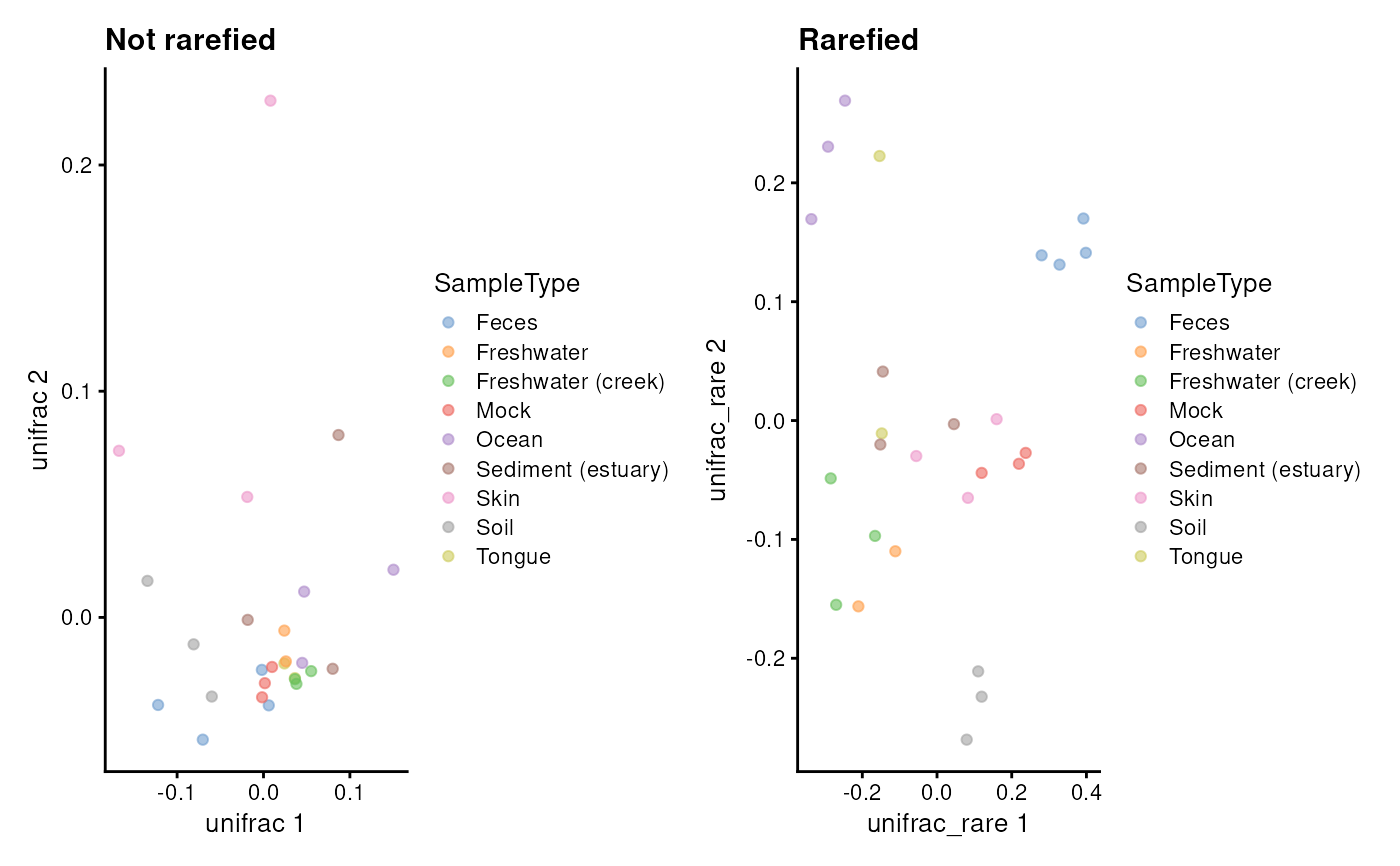
# Calculate PCoA with Unifrac and rarefaction. (Note: increase iterations)
tse <- addMDS(tse, method = "unifrac", name = "unifrac")
#> Warning: Pruning tree...

# Calculate PCoA with Unifrac and rarefaction. (Note: increase iterations)
tse <- addMDS(tse, method = "unifrac", name = "unifrac_rare", niter = 2L)
#> Warning: Pruning tree...
#> Warning: Pruning tree...

# Visualize results
p1 <- plotReducedDim(tse, "unifrac", colour_by = "SampleType") +
    labs(title = "Not rarefied")
p2 <- plotReducedDim(tse, "unifrac_rare", colour_by = "SampleType") +
    labs(title = "Rarefied")
p1 + p2