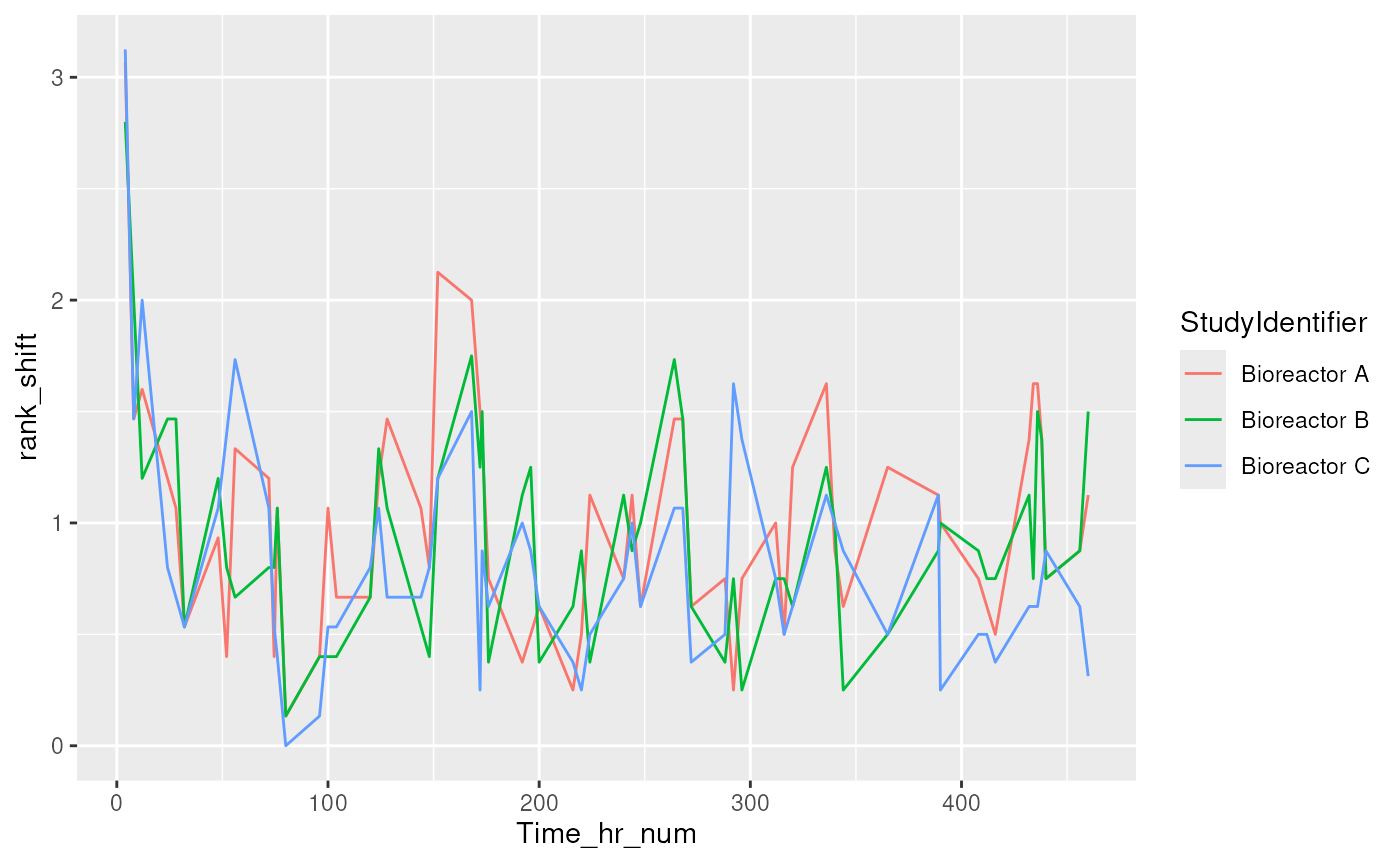
Mean rank shift between consecutive samples
Source:R/AllGenerics.R, R/getRankShift.R
getRankShift.RdCalculates how much the abundance ranks of features change between each sample and the previous sample of the same subject.
getRankShift(x, ...)

addRankShift(x, ...)

# S4 method for class 'SummarizedExperiment'
getRankShift(
  x,
  time.col,
  assay.type = "counts",
  time.interval = 1L,
  time.lag = NULL,
  group = NULL,
  ...
)

# S4 method for class 'SummarizedExperiment'
addRankShift(x, name = c("rank_shift", "time_diff", "ref_samples"), ...)
Arguments
- x
A
SummarizedExperimentobject.- ...
additional arguments.
- time.col
Character scalar. Specifies a name of the column fromcolDatathat identifies the sampling time points for the samples.- assay.type
Character scalar. Specifies which assay values are used in the dissimilarity estimation. (Default:"counts")- time.interval
Integer scalar. Indicates the increment between time steps. By default, the function compares each sample to the previous one. If you need to take every second, every third, or so, time step, then increase this accordingly. (Default:1L)- time.lag
NULLorNumeric scalar. If specified, each sample is compared to the earlier sample whose time is closest totime.lagtime units before it, instead of counting time steps withtime.interval. Useful when samples are not evenly spaced in time. The first sample of each group getsNA. (Default:NULL)- group
Character scalar. Specifies a name of the column fromcolDatathat identifies the grouping of the samples. (Default:NULL)- name
Character vector. Specifies the names of the three columns of results. (Default:c("rank_shift", "time_diff", "ref_samples"))
Value
getRankShift returns a DataFrame with one row per sample and
the rank shift, the time from the previous sample and the previous
sample. addRankShift adds these to colData(x). The first
sample of each subject gets NA.
Details
The mean rank shift (Collins et al. 2008) compares two samples through the
features present (above zero) in both. The features are ranked by
abundance in each sample, with tied values getting their average rank, and
the rank shift is the mean absolute change in rank. It is 0 when the order
of the features does not change. The previous sample is chosen as in
getStepwiseDivergence().
References
Collins SL, et al. (2008) Rank clocks and plant community dynamics. Ecology 89(12), 3534-3541. doi: 10.1890/07-1646.1
See also
Examples
library(miaTime)

# A defined community of 16 species in three replicate bioreactors
data(minimalgut)
tse <- addRankShift(minimalgut, time.col = "Time_hr_num",
    group = "StudyIdentifier")

# Rank shift over time in each bioreactor; the first samples have no
# previous sample
library(ggplot2)
df <- as.data.frame(colData(tse))
df <- df[!is.na(df[["rank_shift"]]), ]
ggplot(df, aes(x = Time_hr_num, y = rank_shift, colour = StudyIdentifier)) +
    geom_line()